Thursday, May 15, 2025

Mid May

It has been raining and raining and I'm guessing the new drought monitor that comes out this week has us out of drought, at least here in Eastern Massachusetts but time will tell. The spring is usually a great time to grow grass, set yourself up for success for the season and try and recover from any issues you experienced last year or in the winter. Sometimes, especially here on Cape Ann, it can be a challenge. Gloucester sticks out into that cold ocean which keeps us much cooler than everywhere else; even a half a mile makes a big difference. This year has been nice though; its been in the 60s and even 70s a few times which is very atypical and much appreciated.

Regular rains have allowed us to get some banged up areas filled in. Areas like the rough get minimal fertilizer but spring is one of the times we feed them a good bit of nitrogen. We utilize a polymer coated, slow release product that gives us a little quick shot of nitrogen and a long slow feed that is released based on water and temperature. This allow us to give the turf a steady diet of what it needs through the summer months. The nitrogen provides the plant with the nutrients it needs to grow roots and shoots in preparation for the stresses of summer when roots shrink significantly and shoot growth is less. 

The negative side of all that growth, at least if you aren't a professional golfer, is that the rough is THICK and lush. The best tip I can give to any golfer playing in the spring is "hit it straight and keep it in the short grass". Its like this everywhere right now. The staff has gone around this week knocking back the fescue mounding to more reasonable lengths and has made a few cutline adjustments most notable is the mounding on the 17th hole. 

This past Monday we were closed for the entire day which allowed us to get some very small coring tines into the greens, remove a tiny bit of thatch, get some air in to help dry them out after last week's deluge and put a light dusting of sand. We also got a ton of grass cut, a couple sprays out and other odds and ends. We followed up with a light verticut on approaches to remove some thatch and will follow that up with some sand as well. The purpose of this cultural practice is to firm up the surfaces in front of the greens to allow balls to better feed onto the putting surfaces. We played around with the settings on the 14th hole which ended up being slightly more aggressive than I wanted. I also noticed that slicing side to side may grab your club a little so we adjusted to a different direction that is with the line of play to improve playability. 

We are working on creating a temporary green to be utilized for the 7th hole while the new is being constructed and is out of play. It will be circled in white and should be considered Ground Under Repair.  Please take a drop from this area. It will be continuously aerated and topdressed throughout the season to help it firm up before the height is slowly lowered. It won't be exactly like a green by any stretch of the imagination but we want to give you something better than just putting on fairway turf. 

The annual flowers will be going in the ground next week and I'm hoping the tennis patio will wrap up soon as well. We pulled out the old, unruly variety of hydrangeas that were planted in front of the ladies locker room and Cheryl installed a few different varieties along with some grasses that should neaten that area up. 

Our seasonal staff which is mostly comprised of college students and a couple of high schoolers are trickling in this week and next with the high schoolers helping out just on weekends right now. We are happy to have Jackson Colbert, Brooks Slingluff and Aiden Doke back from their first year of college. They look no worse for the wear and are ready to get back at it. We also have a couple new staff members in Chris Esposito and your own Drew Johnson. Please have patience as the greenheads learn the rules and protocols.


Wednesday, April 9, 2025

Open!

It has been a weird couple of weeks since the last post and the first update of 2025. I thought it might be helpful to touch on a few other items and keep people in the loop on what to expect the next few weeks. 


It is 28° here this morning as I put this together before we open the course today at 10am even after yesterday afternoons snow squall. Consider today and the next couple weeks a soft opening before we have our actual Opening Day later this month. We will be spending time going through the bunkers, adding sand, prepping plant gardens, fixing paths and cleaning up other slightly damaged areas from the winter traffic and a few projects that have been undertaken over the last few months. 

The turf is growing ever so slowly, especially the greens now that the covers have been off for a couple weeks and they are reacclimating to the cold. The greens will be maintained quite a bit longer while we stay cold here through April and into early May in order to help build roots and carbohydrate stores for the summer. This is even more important this spring as we experienced a significant drought last fall and are still in the midst of it. It has rained 8 out of the last 9 days here in April but we are still in a drought. According to the current Massachusetts Drought Monitor we are still in a Critical Drought. The ponds might be full and the ground saturated but the levels in reservoirs are still quite low with the area being 8-10 inches below normal for the last 6 months or so. This will require those of us with water withdrawal permits to follow our Seasonal Demand Management Plans as well as institute our Water Conservation Plans. We will be required to cut back usage to mandated levels until the status changes. We are hoping for a few isolated heavy rainfall events that will fill drinking water storage areas statewide sooner rather than later and then, of course, a once or twice a week rain event throughout the season.


The next few weeks will be busy for us as we begin to put our seasonal applications for broadleaf and grassy weeds, seedhead suppression materials, slow release fertilizers on longer turf among other things. These products will  be applied based on weather forecasts, soil temperatures, scouting, plant signifiers among other things. As always, spring is "organized chaos" for even the best golf course maintenance teams. Its always nice to see golfers back on the course even though we enjoyed having the course mostly to ourselves (and the geese) for the last couple of months. Safety nets on 4 and 17 will go up tomorrow, tennis court windscreens will go up over the next few weeks as well as many other accessories. Please, as always remember that this is your course, replace your divots, fix your ballmarks and rake your bunkers. Do it for yourself and your fellow members, especially the groups playing behind you! 


Monday, March 31, 2025

Almost April 2025

It is that time of year where the ground thaws, grass starts to green up and buds start to pop on the trees. Temperature variations last weekend were insane across New England with some places hitting 80° while we were sitting at 33° with snow flurries and Portland, Maine had 5 inches of snow! The good weather is coming, I'm just not sure when. At least we kind of had a winter this year with a few snow events and rain that turned into ice. 

The maintenance team was busy with snow cleanup as well as equipment maintenance. We are wrapping up our service work on all of the equipment as we speak. Everything has been serviced and inspected with a fine toothed comb, detailed and painted. Cutting reels have been rebuilt, blades sharpened, supplies have been refurbished and the shop straightened out. Continuing education classes were a focus for the professional staff allowing for licenses to remain up to date and exposure to some amazing new technologies in the turf field. Our staff lineup will be a little different this season but we have hired some new seasonal help and are excited for them to start in early May, get them trained and productive. 


There's definitely a lot going on. A new tennis patio is underway by the upper tennis courts. An amphitheater style patio with a sitting wall is taking shape. Natural rock veneer will be utilized with a bluestone cap, accent lighting and some plantings will finish the area off. This will be a nice addition to the area for the summer.

The greens were aerated on March 11th, 12th and 13th. We uncovered the greens, applied a heavy sand topdressing, aerated with 3/4" tines, brushed the holes full, rolled them and covered them back up. I am thankful for an experienced and dedicated staff; we were a well oiled machine. Covers were permanently removed early last week; the greens made it through in pretty good shape, were rolled six times before mowing and making our first poa annua seedhead suppression application last Friday. Tee covers will come off this week followed by a mow and a seedhead and fungicide spray as well. We are looking ahead and aiming to open the greens sometime around the weekend of the Masters if the weather cooperates. 


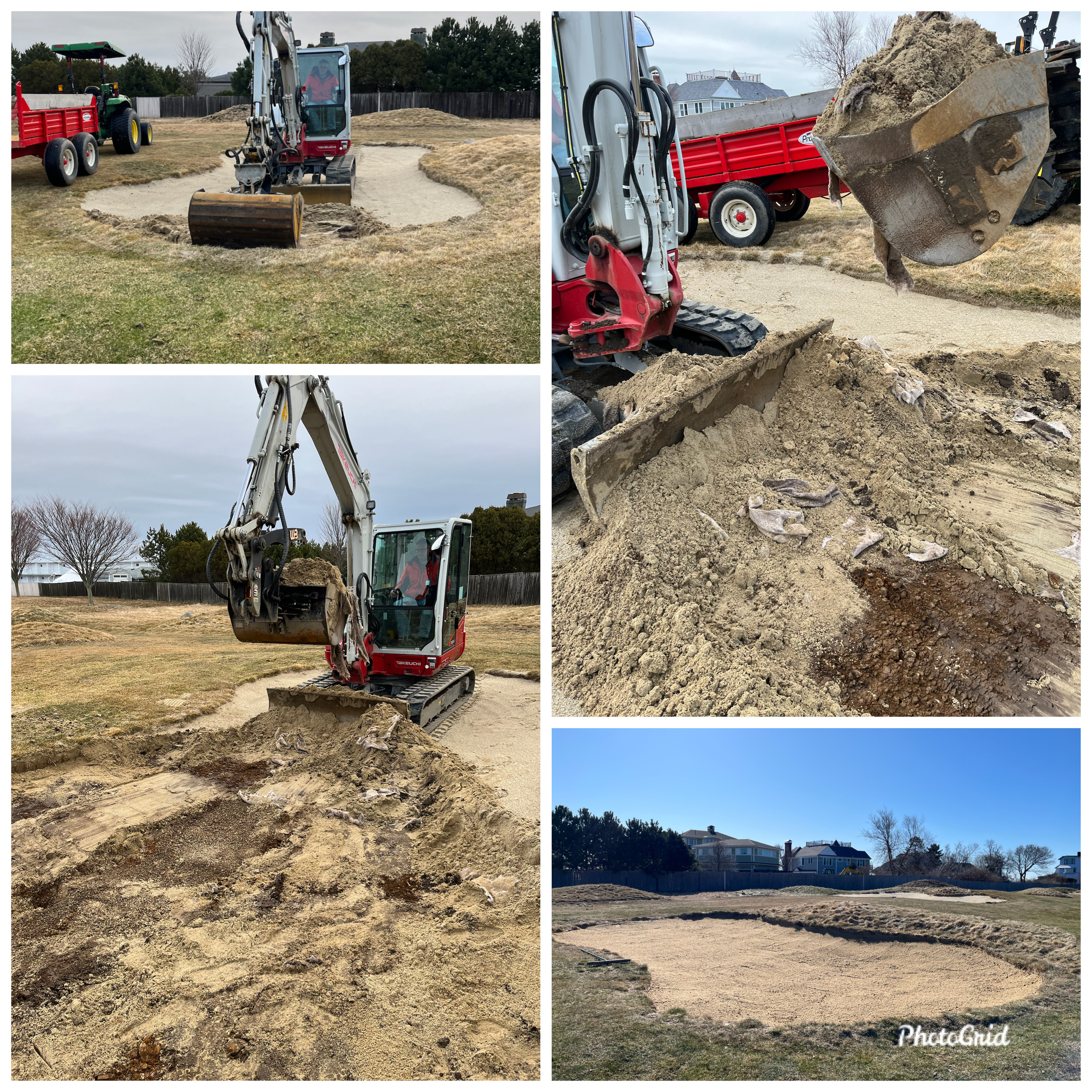
The course has been cleaned up of sticks and debris, the irrigation system has been charged and tested, on course bathrooms are turned on but will remain closed until they are cleaned and some other items addressed. We have changed out some sand and removed an old liner on the 4th hole and will continue to work on course preparations in the coming weeks and months. We will be bouncing back and forth between items on the course and around the clubhouse as the weather changes; the soft wet conditions make it sometimes difficult to get around the course without making a mess and more work. We reworked the parking area by our greens nursery/practice area in an effort to keep people off the grass on the first hole. We also added some cobble edging by the 2nd green and hope to add some more as time allows.

We are also working on the initial stages of a future project to increase our pond storage capacities on holes 1 and 18. A feasibility study is underway looking at the current conditions, environmental conditions, existing soil makeup, sedimentation quantities and dredging or expansion possibilities. The newly approved Enhancement Plan that was developed by our architect Robert McNeil is the blueprint for any modifications. Once the results of the study are in hand we will be able to look forward at the options. Increasing our water storing capabilities is critical to future course management. 


The 7th green is slated to begin in August after the Michael Burke Invitational; we have been moving fill material out there all winter in an effort to minimize disruption to membership. The site is difficult to access and material needed to be delivered in small load of 3-4 yards at a time. Lets just say there were hundreds of loads brought over the last few months. We will level out the area and seed it for stability until the time comes to start the project. It is an extremely challenging site with a lot of unknowns under the existing green. We know there is rock, just not exactly where or how much. The architect's goal is to utilize what is there underneath to create as natural a feel as possible. The green will be built in a similar fashion to the 2nd green with a modified USGA sand base over a gravel layer and seeded and plugged with cores from our existing greens. This will give us a surface that will be similar to our other greens and should probably be ready around Memorial Day of 2026.


Thursday, October 3, 2024

October 2024: Summer Synopsis and Master Plan Update

We are enjoying another beautiful New England fall with great weather and good golfing conditions the last few months. This summer was quite a challenge with the extreme weather but fall is here and the last bit of good golfing weather is ahead of us. We weathered the storm of extremes and high volume golf and are continuing to look at the future with the newly received Golf Course Enhancement Plan that will be discussed on October 16th at 5pm in the clubhouse. Please attend what I expect to be an informative meeting with our golf course architect Robert McNeil; this will be the blueprint for course modifications as the club moves forward. I'll give you an update on a few on course items, summarize the summer and provide some background on the planning process as we've worked through it the past 12 months or so.

What a summer, a scorching hot and humid July with just about no rain in July, August and most of September. When we did get some rain it measured just about 0.1" on the rain gauge which lasts the plants about half a day!  Thank goodness for the new irrigation system which allowed us to put water in more places than the old system, with more precision, control and stretched our resources as far as we could. The wells ran all summer long and by the end were producing half their usual volume. Water quality was less than desirable with two of our wells becoming completely unusable with salt contents at three times the recommended level of sodium; using this water would quite literally kill the turf. I'm monitoring the sodium levels on a daily basis and check soil tests a few times a year. Thankfully the longest stretch of no rain for 33 days came after aeration in mid August and the weather was much cooler at night with a few dewy mornings. At the end, we actually had to buy water from the city for 6 days to get us through. The rest of the fall should be manageable so long as we don't get any crazy fluctuations and an occasional rain event.

This extended period of dry weather and well water usage does create an issue in our soils. The salt air already creates a challenge with fog off the ocean depositing salt crystals on leaf blades as it burns off. Again, salts are the main ingredients in weed and grass killers so natural rain or good clean irrigation water is important. When you don't have both or either of these you need to get out your chemistry set, wave a magic wand and try to manipulate the environment. I am not surprised that our recent tests are showing some really high levels of sodium. This can be somewhat remediated or modified by adding some other nutrients with stronger electron bonds like calcium, magnesium and potassium in the right amounts, at the right time and in the proper order. Today we started by adding some calcium sulfate (gypsum) to the greens in a granular form. We did about half the greens today and will do the others sometime next week. Once this product is applied we quite literally flood the green with water to get it into solution and into the top few inches of the soil profile; we will repeat this again this evening. This will create a situation where the calcium will come into contact with the sodium that is stuck on the soil colloids and quite literally kick the sodium off. Calcium is sodium's stronger big brother so it replaces the sodium on the soil and then flushes out of the profile. This requires a lot of water to ensure it makes it out the bottom of the root zone. We will follow up in a few weeks with a different calcium source and then some potassium later in the fall.

As I mentioned already the architect will be here on October 16th to show membership the new Enhancement Plan for the golf course; I strongly recommend that everyone attend if you can. The plan has been created to provide a blueprint for future changes and improvements to the course and to ensure that there is a consistent design style for the property. Bass Rocks had a plan previously put together in 2001 and has been the greens committee's guide for the past 20 plus years. Club membership, changes in demographics as well as people's priorities change over time and after 23 years it was time to update this document and help plan future course improvements. The plan makes it easy to maintain continuity for years as committees and boards change. The main areas of interest had to do with neighbor concerns, water retention and flooding issues, green, tee and bunker updates and enhancing the practice facility. Robert was initially tasked with addressing these areas with the following goals in no specific order:

1. Maintain the feel of Bass Rocks with rock features and seaside vistas.

2. Balance functional improvements like cart paths and drainage with enhancement opportunities like bunkers, greens and mounding.

3. Create visual and strategic interest on the wide open holes like 11, 12 and the meadows.

4.  Develop a plan that make the course more challenging for the lower handicap golfer without penalizing the higher handicapper.

5. Create a plan that accomplishes the other goals efficiently and cost effectively without adding unnecessary labor intensive maintenance challenges.

6. Have some flexibility regarding construction due to challenges such as rock and ledge outcroppings.

I sincerely hope many of you can make the meeting, see what Robert has to say and ask lots of questions. As a teaser I can tell you that the 7th hole is well represented in the plan! I am also happy to answer any questions you may have about the plan if you don't have the ability to make the meeting or simply want to know more. 


Wednesday, May 22, 2024

Memorial Day and poa annua- Our Grass

Its here, Memorial Day Weekend, and welcome home to all of you who went south and were wise enough to stay and avoid the cold! Summer has arrived here on Cape Ann, at least for a couple of days. A month has passed since the last blog post and things are really starting to brighten up. Cheryl and the team
from Plant Creations were here last weekend installing our annuals and we have mulched the beds around the clubhouse; the tulips were nice while they lasted. We have also been busy getting out or preventative applications for seedheads, weeds, insects and growth regulation course wide.  The trees are almost all leafed out and the bentgrass has finally started to green up as temperatures are rising out here in the middle of the ocean. Our college crew has been trickling in the last week and a half and a solid crew of Rockport High School students has been working on weekends.  We won't have the Vikings in full force for a few more weeks until they are done with school; please be patient as most of them are greenheads that will need some training.  This last week we did our initial mowing for the native areas along with a weed and growth regulator application. We will continue to mow these every 2-3 weeks throughout the season. Did I mention that the rough is growing like crazy and dreaded pollen is in full effect? 

If your eyes are watering, your throat is scratchy or you have a headache like me you might have allergies and the golf course is a great place to torture yourself with all things related to these seasonal nuisances. Thank God for Zyrtec; I always know mine are about to kick in as soon as I see the poa annua seedheads. Yes, believe it or not, I am allergic to grass like many of you, poa annua. 

Poa annua
, or annual bluegrass, is one of the main grasses here at Bass Rocks; we have it on every playing surface, it is our primary putting surface as well. It is very well adapted to coastal climates with cool, moist environments and moderate winter weather.  It makes a great putting surface with a dense, upright growth habit. Poa annua is the main plant type at other famous courses like Pebble Beach, Spyglass Hill and Oakmont C.C. Johnny Miller always loved to talk about how poa greens get bumpy in the afternoon. Poa annua is a great plant but it does have a few challenges, one of which is their seedhead which becomes very prominent this time of year. They push up very quickly during the afternoon even after a morning mowing and make greens putting surfaces bumpy. Treating green surfaces to prevent them from forming is a hit or miss battle, over time we have settled into a multiple application protocol with great success. You will see the seeds formed densely on fairways and roughs the next few weeks which will make your efforts of getting out of the rough just a little bit tougher. We will be cutting rough and blowing the clippings more than normal to keep up with their huge push. Greens mowers will be using the ultra groomer attachments to try and harvest any seeds that do push through our control applications. 

The next challenge with poa annua is that its a favorite delicacy of the annual bluegrass weevil. Weevil larvae are munching hard the next few weeks as they complete their life cycle just as we get close to Father's Day and just as the plant is about to complete its life cycle. We work hard all spring scouting for the overwintering adults as they march out to lay eggs in an effort to keep their brood going. Last but certainly not least is the biggest challenge of all. Poa annua is an annual plant meaning it only lives for one year. It produces the seedhead as its last gasp before it plans to go off to greener pastures. It is supposed to die and here we are trying to keep it alive just as we are getting into the hottest time of the year. After poa finishes its seeding it will start to yellow and start to wither. We will be all hands on deck from that point through the fall trying to keep it alive. Small but exacting fertilizer combinations with micronutrients and organic plant and seaweed based products will be applied to manage the plant and keep it chugging through the summer. Precise moisture monitoring and watering methods will be utilized to promote root and shoot health while managing the surfaces for speed, trueness and color. Add in a little bit of, "keep it healthy but not too healthy" to the mix with regular mowing, rolling and topdressing and you have a successful year at the club. 

The maintenance team will be working hard to give you just exactly that all season long. Let's kick off the summer this weekend with our families, a cookout or two, take in a round of golf or a game of tennis and enjoy the views of the ice cold 52° Atlantic Ocean.